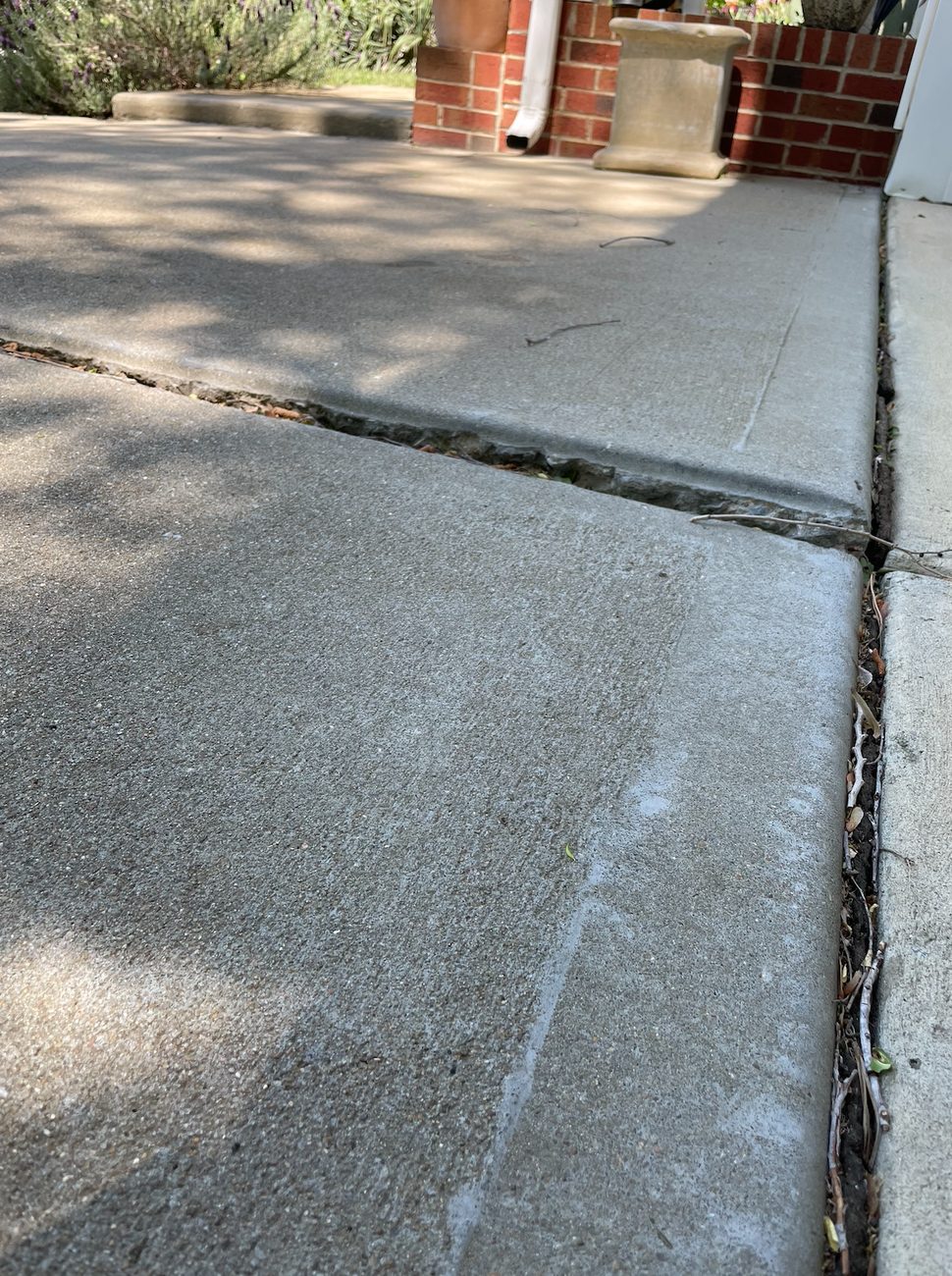
It starts small. Damp air in the basement, a stain after a hard rain, then water pooling where it shouldn’t. We waterproof basements, repair foundations, and encapsulate crawl spaces across Greenville, from North Main’s older homes to the newer builds in Hollingsworth Park. Free inspection, and we’ll tell you straight.
Get Your Free Inspection
We appreciate you reaching out.
One of our team members will be with you shortly.




What to Watch For
Water gets in first, and the rest follows. It shows up as a stain, then a smell, then a floor that gives when you walk it. Around Greenville the clay sits on weathered rock, so when it rains hard the water can’t drain down. It runs sideways, into whatever’s in the way.
Water Pooling Against the House
Standing water by the wall after a storm goes somewhere, and that somewhere is down along the footing. Regrading and a French drain give it an exit.
A Crack That Weeps After Rain
A crack that’s dry all week and darkens after a storm is an open path through the wall. Injection seals it, but the water outside still needs handling.
Damp, Musty Air Downstairs
That smell is humid air sitting on damp block and bare ground. A dehumidifier masks it. Sealing the space and cutting the water off ends it.
A Basement Wall Bowing In
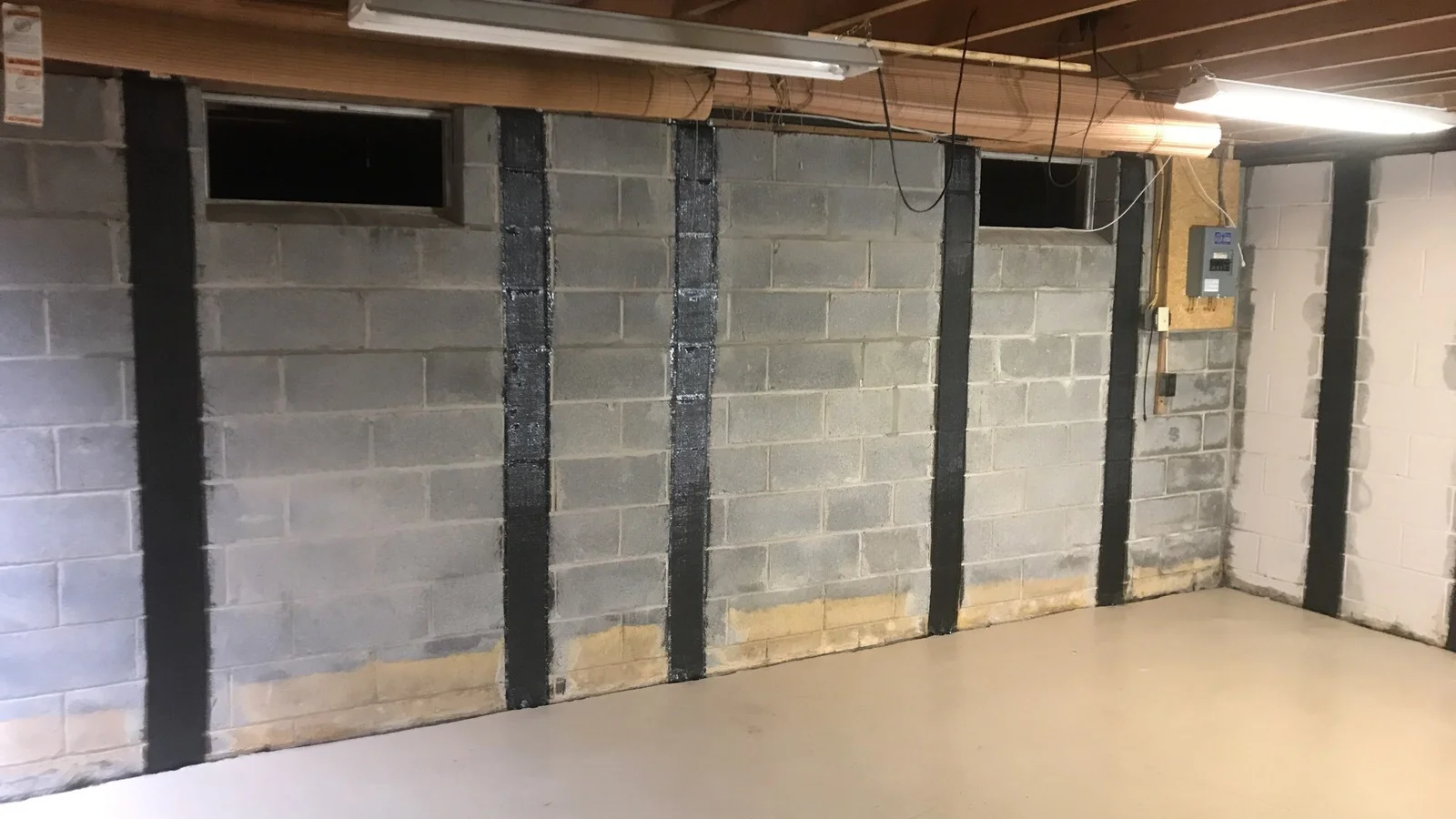
Wet clay against a block wall pushes hard, and it bows in before it cracks. Carbon fiber straps or anchors hold it, once the water pressure is handled.
Floors That Dip or Feel Soft
A floor that sags or gives underfoot is either settling below or joists that have taken on moisture for years. We figure out which before picking a fix.
Doors and Windows That Stick
A door that won’t latch when nothing else about the house changed is a frame knocked out of square from below. Piers put it back for good.
A crack that weeps after rain is telling you something a dry crack is not. Water is finding a path through the wall, and it will keep using it. A wall bowing inward is the same water seen from the other side, because ground that stays saturated pushes. If you want to know which kind you are looking at, we will come out and say so at no cost to you.
Water and movement are usually the same story told two ways, so we handle both. Tap any service to see what the work actually involves, and when it’s honestly not the fix you need.
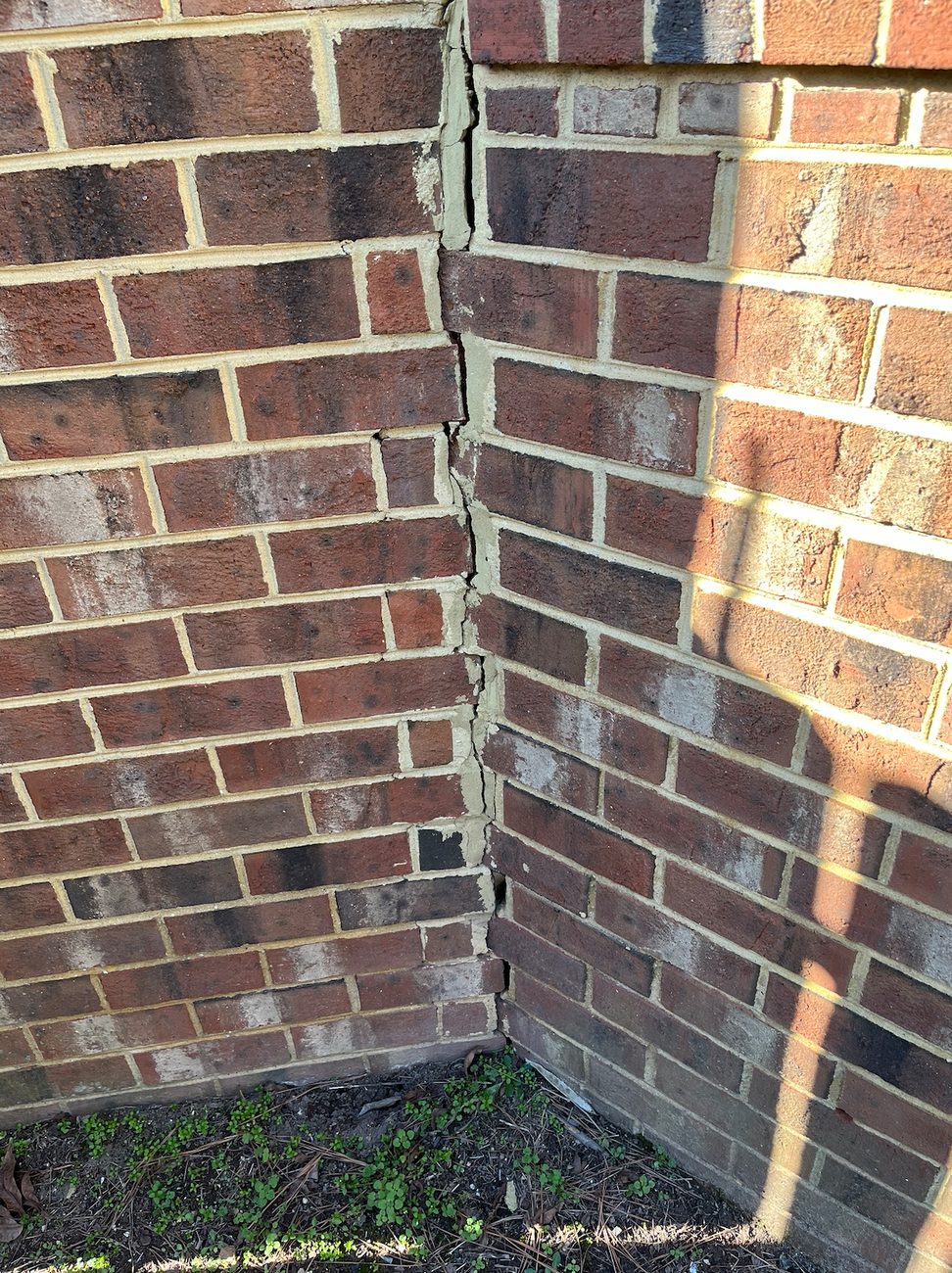
The permanent fix for a foundation that’s settling. Piers carry the weight down to competent rock, then we close the cracks and bring the floors back to level.
Learn moreUnder Greenville the dirt doesn’t just stop and turn into rock. Clay gives way to saprolite, granite that’s been rotting in place for a few million years, and under that is solid rock. How far down changes from one lot to the next, sometimes from one corner of a house to the other. That’s what makes settlement here uneven. One end of the house finds something to sit on and the other keeps going.
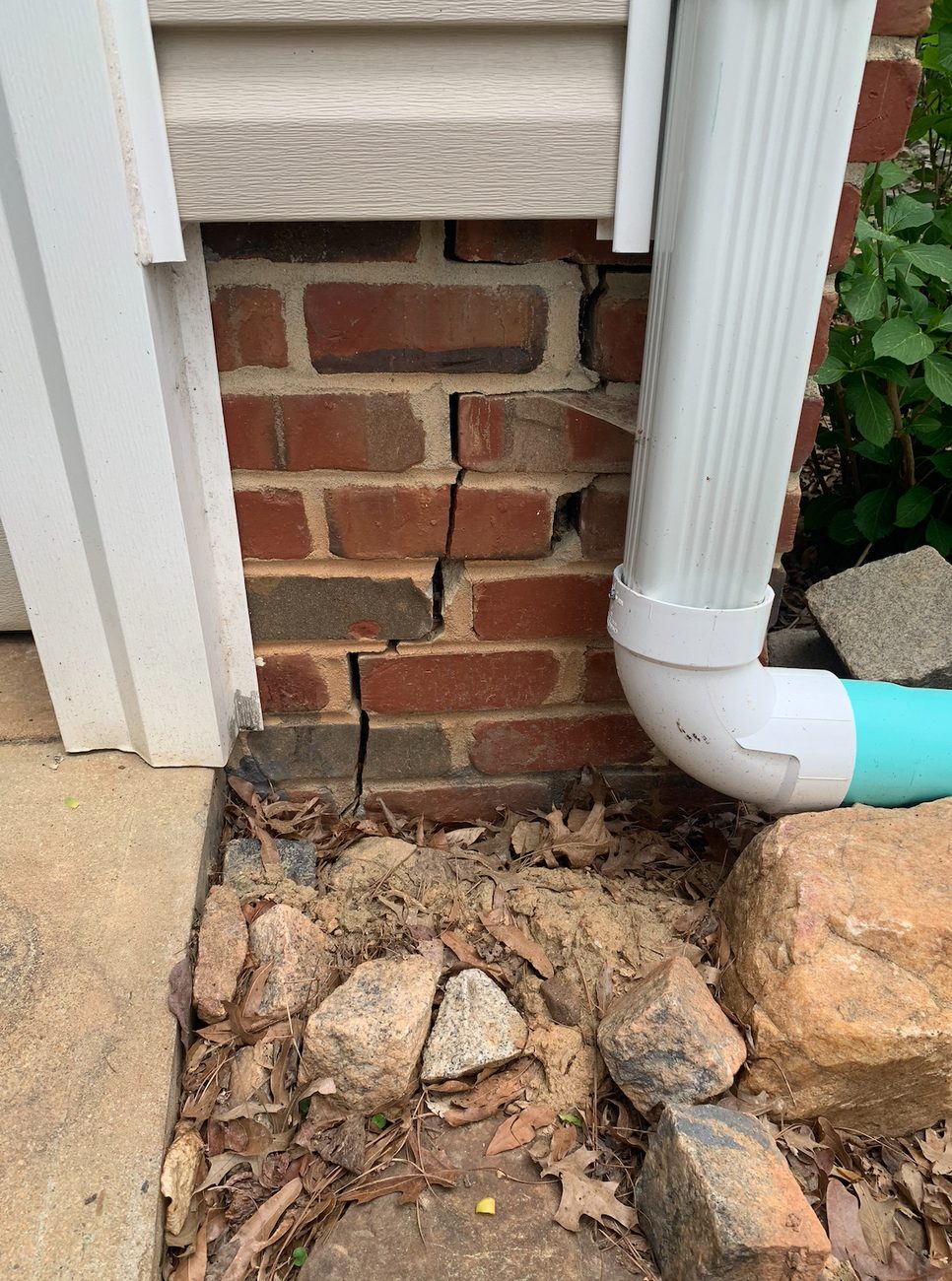
You feel it before you see it. A door that stops latching, a crack stepping up through the brick, a floor that runs downhill toward an outside wall. It turns up in the older places off Earle Street, where the houses have had a century to find their level. It shows up just as often in newer builds around Hollingsworth Park, where the lot was cut and filled to make it flat.
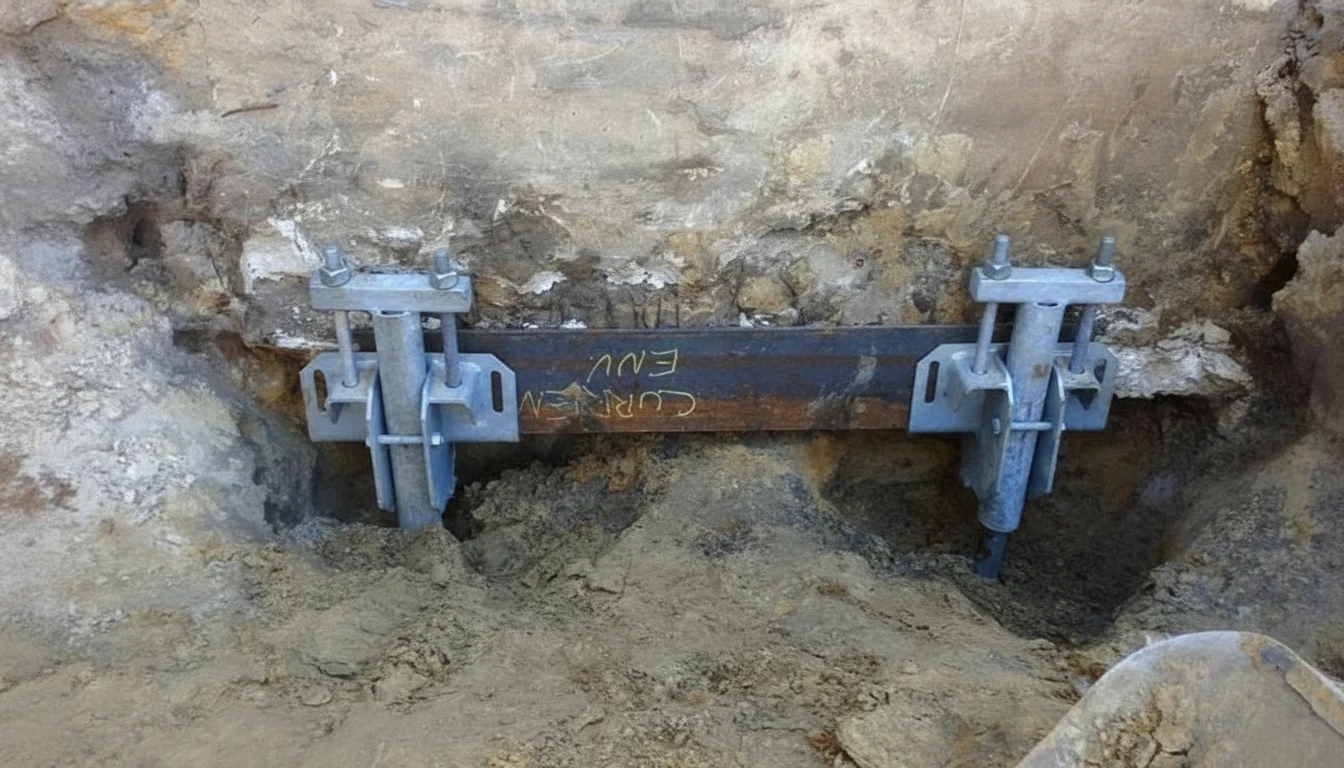
The fix depends on what’s actually moving. Push piers work where the house is heavy enough to drive them down. Helical piers turn to a set torque, which matters more here than most places, because we’re chasing rock that isn’t at a predictable depth and torque tells us we’ve reached it before we put any weight on it. Crawl space supports are a different repair for a different problem. And sometimes the honest answer is that the foundation is fine and the water around it isn’t, in which case drainage costs a fraction of piers and does more for the house. We’ll tell you which of those you’re looking at. The inspection is free.
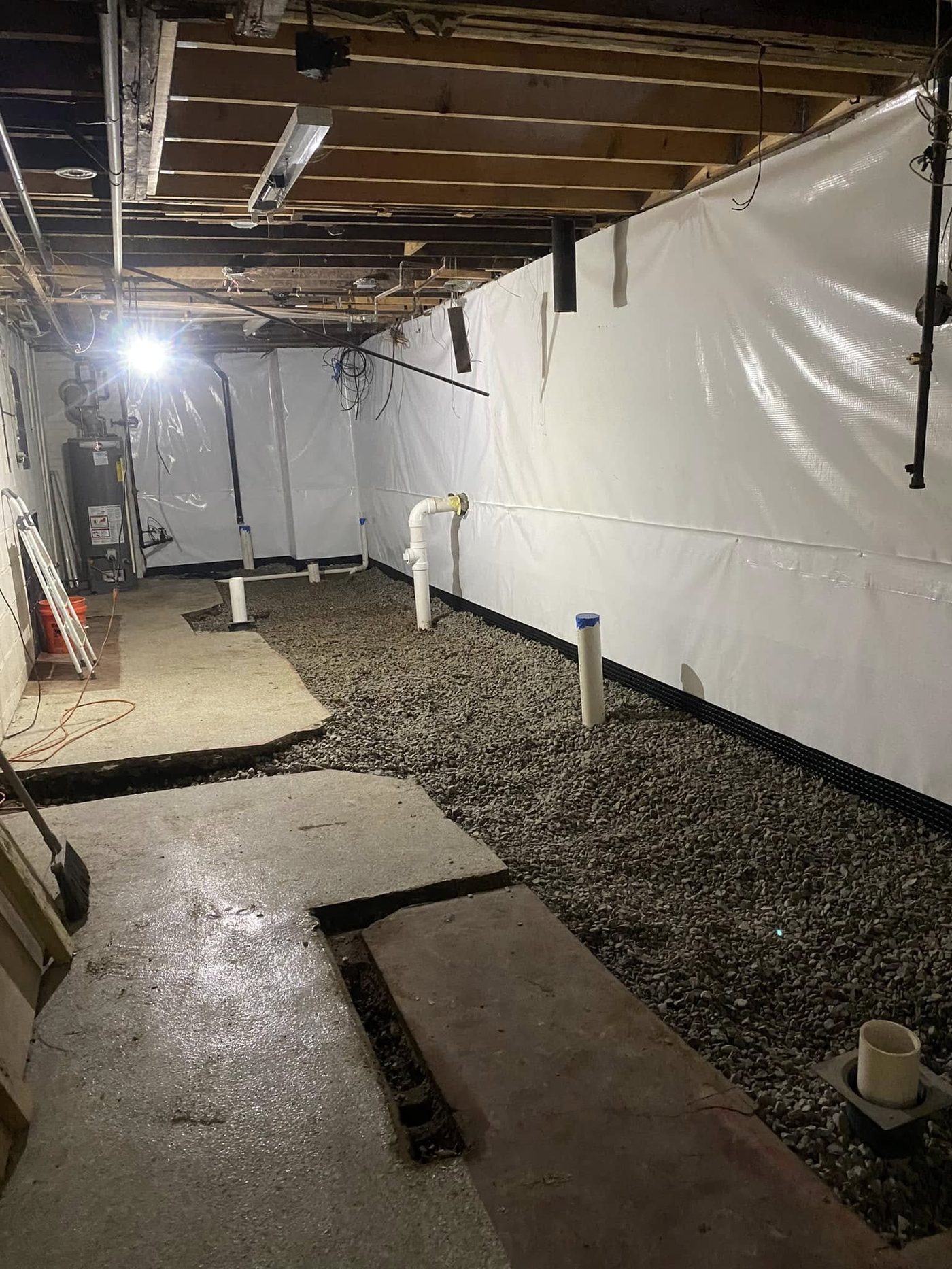
Greenville has real basements, and real wet ones. We find where the water gets in, stop it at that point, and give the rest somewhere to go.
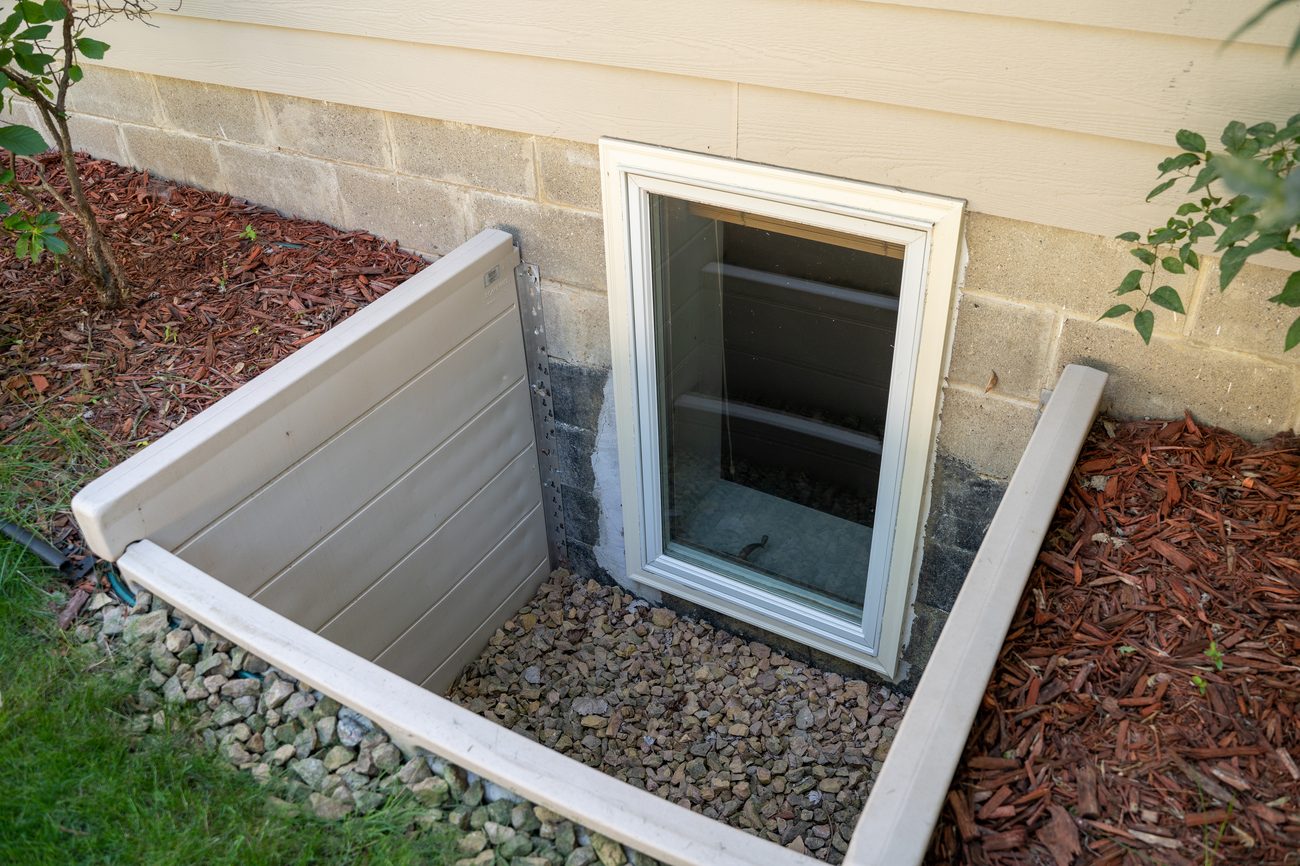
Learn moreGreenville sits up against the foothills, so unlike a lot of the Carolinas, real basements are common here. That also means real wet basements. When it rains hard, water moves down through the clay until it hits saprolite, and that’s where it stalls. It can’t sink, so it spreads sideways along that layer until it finds your wall, and then it pushes.
You’ll see it as a dark line low on the block, a stain that comes back every storm, or an inch of water in the corner by the stairs. The older basements around North Main usually leak at the joint where the wall meets the floor. Newer ones out toward Montebello leak at tie rods and cold joints instead.
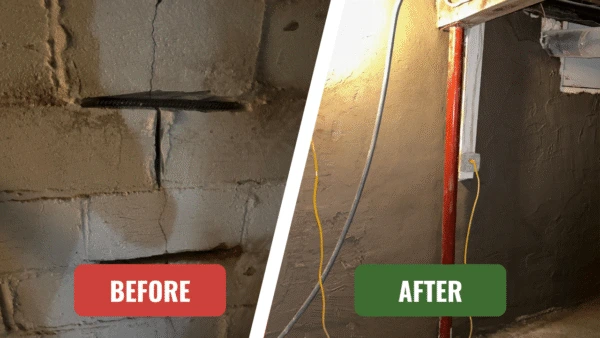
How we stop it depends on where it’s getting in. An interior drain around the footing catches water before it reaches the slab and sends it to a sump. Exterior work costs more but handles it before it ever touches the wall. Crack injection seals a single path, and it’s the right call more often than people expect. A wall that leaks in exactly one spot after a storm doesn’t need a drain system. Regrading and downspout extensions fix the ones caused by water that never should have been there. Most basements need two of those, not all of them, and we’ve talked plenty of people out of the expensive version when the cheap one would hold. The inspection is free.
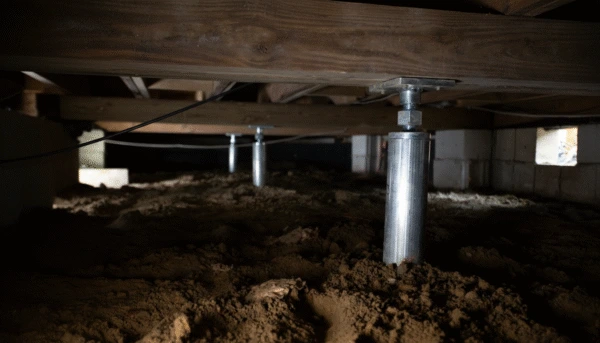
When the damage is already done. Joists gone soft, supports sunk into the dirt, a floor that gives when you cross it. We rebuild what’s holding it up.
Learn moreNot every Greenville house has a basement. Plenty sit over a crawl space, and the ones that do have a different problem. The ground under there stays damp, and damp air and wood are a slow disaster. Wood doesn’t fail all at once. It gives up a little at a time, and the load it stops carrying goes to whatever is next to it.
You notice it upstairs first. A springy spot in the hall, a floor that slopes toward the outside wall, a door that won’t sit square anymore because the floor under it dropped. It’s common in the older stock around Hampton-Pinckney, where the joists are eighty or a hundred years old. Same story over in West End, where the piers under them have settled into soft ground.
What it takes depends on how far it went. Sometimes it’s new supports set on proper footings to take the sag out. Sometimes a beam or a run of joists is too far gone and gets sistered or replaced. Adjustable steel jacks let us bring a floor back up slowly, over weeks, instead of cracking the drywall above it by rushing. Rotted subfloor near a plumbing leak is its own repair and has nothing to do with the foundation. And none of it lasts if the crawl stays wet, so the moisture has to get handled at the same time or you’ll be doing this again. We’ll show you photos of what’s down there before we quote anything. The inspection is free.
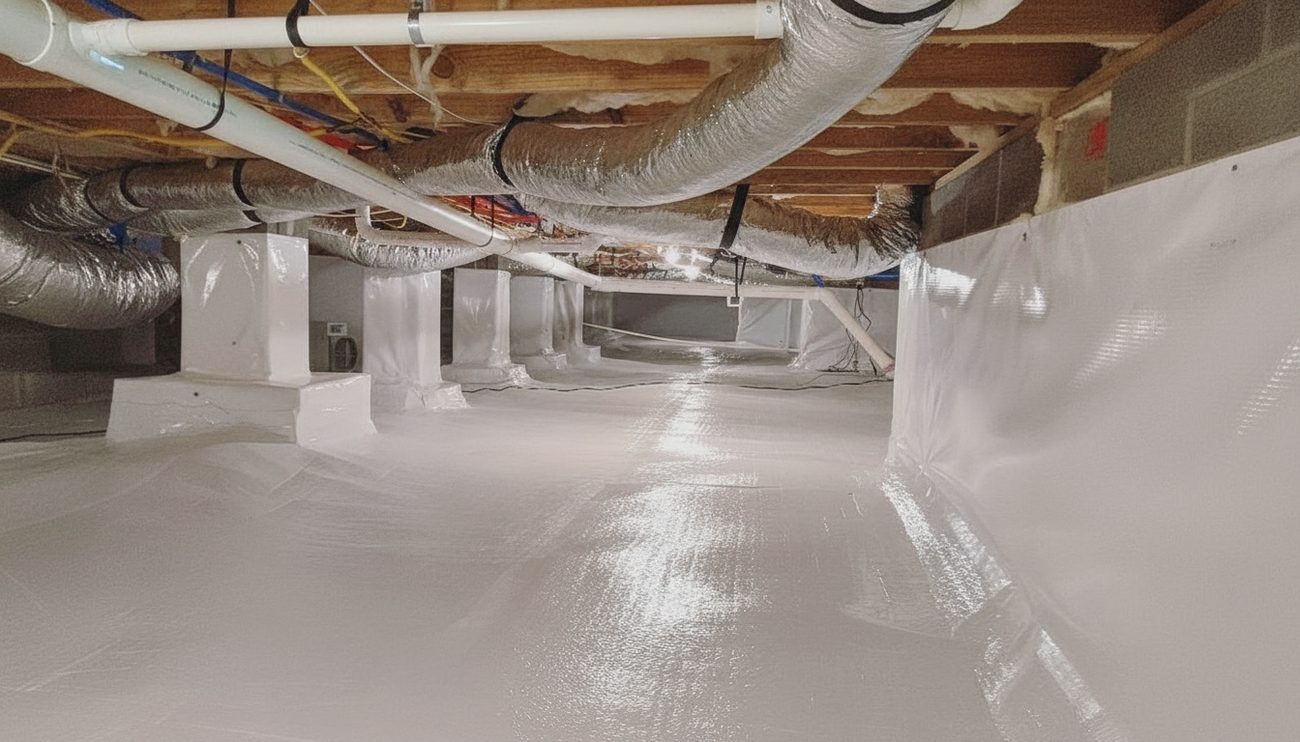
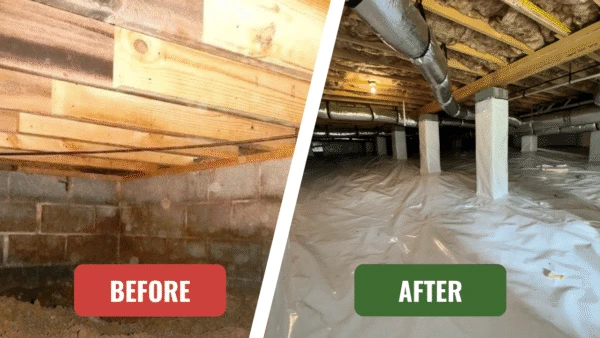
Seals the crawl off from damp ground and humid air, the cause of the musty smell, the mold on the joists, and the floors that cup above it.
Learn moreAn open crawl space is a vent for whatever the weather’s doing. Greenville summers are humid, and that warm wet air drifts through the foundation vents, hits the cool ground under the house, and condenses. Now you’ve got water on the joists that didn’t come from a leak or a storm. It came from the air.
You smell it before you see it. Musty air in the hall closet, hardwood that starts to cup, insulation hanging down because it got heavy and let go. Houses around Botany Woods deal with this a lot. So do the ones over by Parkins Mill, older crawls with open vents and bare dirt floors that were built the way everybody built them at the time.
Encapsulation seals the whole space off. Heavy liner across the floor and up the walls, seams taped, vents closed, and a dehumidifier sized to the space and set to hold it there. It is not the same as a vapor barrier. A vapor barrier is plastic laid over the dirt to slow moisture coming up out of the ground. Encapsulation seals the ground and the walls and controls the air, which is where most of the water in a Greenville crawl actually comes from. If your crawl is dry and the liner’s intact, you may not need any of this, and we’ll say so. If groundwater is coming in, encapsulation alone won’t hold, and that needs a drain first. The inspection is free.
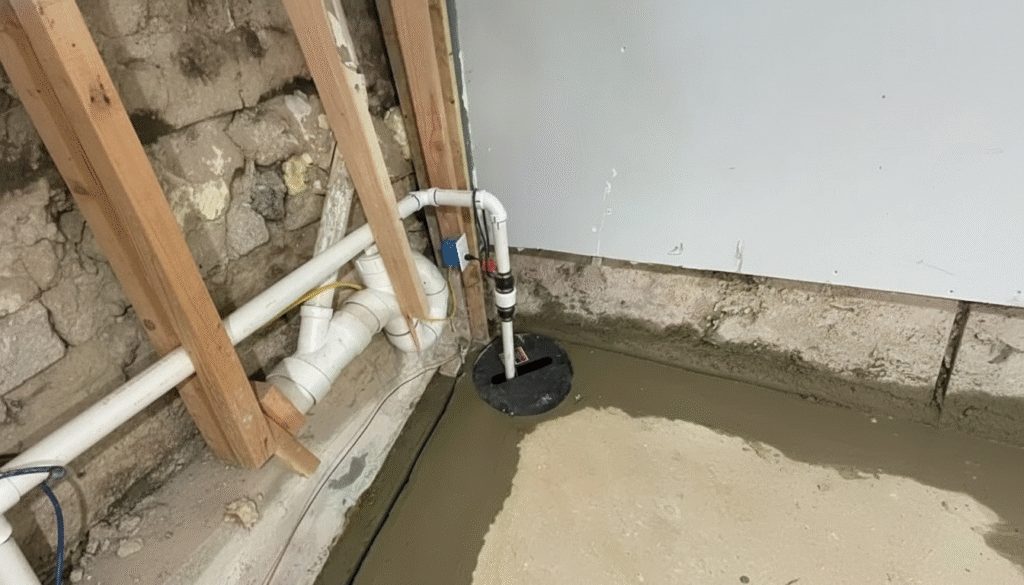
The last line of defense for water that gets in anyway. A basin catches it at the low point and pumps it out, automatically, every time it rises.
Learn moreEvery basement has a low corner, and water finds it. A sump pump doesn’t stop the water from coming. It gives it somewhere to collect and a way back out, on its own, without anyone having to be home. That last part is the whole point. A pump only earns its keep on the day nobody is there to bail.
The older basements around Overbrook were never built with one, so the basin gets cut into the slab after the fact. Around Chanticleer we more often find a pit already there with a builder-grade pump in it, sized for a wet week and not a wet season. Either way, the pit matters as much as the pump.
The pump is the easy part. What matters is the rest of it. A check valve so the water you just pumped out doesn’t run back down the pipe. A discharge line that carries it far enough from the house that it isn’t just making a loop. A sealed lid, because an open pit is a humidity source. And a battery backup, because the storm that floods your basement is the same storm that takes the power out, which is the one thing nobody mentions when they sell you a pump. If your basement only gets damp and never pools, you may not need a pump at all. Drainage might be the whole answer. We’ll tell you that before we quote it. The inspection is free.
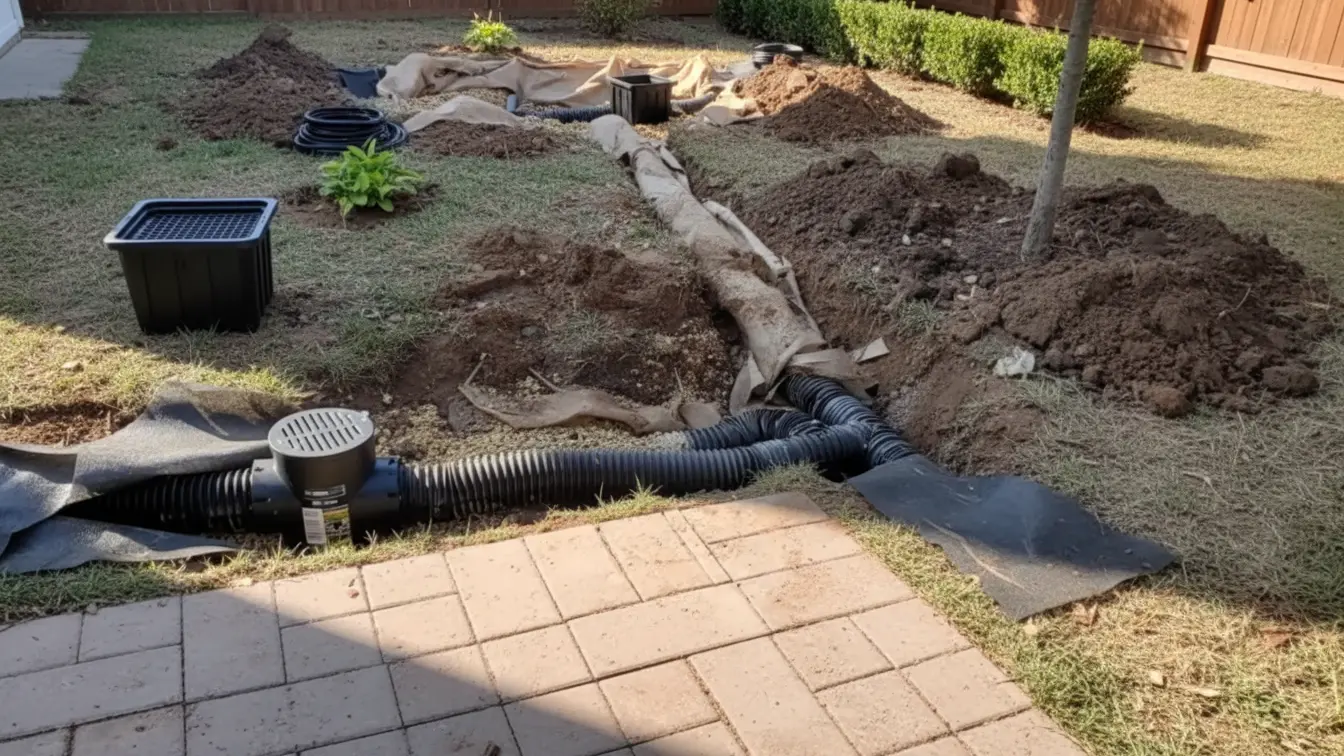
Catches the water before it ever reaches the house. A gravel trench and a perforated pipe give it an easier path downhill, away from the foundation.
Learn moreGreenville gets somewhere near fifty inches of rain a year, and the clay it lands on doesn’t drink it. It sheds it. So the water travels along the surface and just under it, looking for the lowest thing in its path. Often the lowest thing in its path is your foundation, and it has all the time in the world to get there.
You see it outside before you feel it indoors. A yard that stays soggy three days after the rain stops. Mulch washed across the driveway. A low spot still holding water long after everything around it has dried out. Around Augusta Road the lots are flat enough that water sits instead of leaving. Over in Heritage the grade runs toward the houses, so it arrives with some speed behind it.
A french drain is a trench, gravel, and a perforated pipe, and the whole trick is where it goes and how much fall it has. Uphill of the house, it intercepts. At the footing, it relieves pressure. Neither one works if the outlet sits higher than the trench, which we find more often than you’d think. And sometimes the fix isn’t a drain at all. Downspouts dumping at the corner and a grade that slopes back toward the house cause most of what we get called out for, and both are cheap to correct. We’ll start there if that’s what’s actually wrong, and a trench nobody needed is just an expensive hole. The inspection is free.
Queen Foundation Repair does foundation, basement, and crawl space work in Greenville. Most of what we get called out for here is water. The foothills mean these houses have real basements, which isn’t true of much of the Carolinas, and a real basement is a thing water can get into. Older places off Earle Street tend to be block, and block leaks where the wall meets the floor. Newer builds out around Hollingsworth Park leak somewhere else entirely.
The inspection is free, and a good share of the time it ends with us telling you the crack you’re looking at is cosmetic and to leave it alone. When something does need doing, you get a written scope and a price before anyone starts, and the warranty transfers if you sell. Drainage fixes more of these than piers do, and it costs a fraction of what piers cost. So that’s usually where we start.
The question everybody asks first is whether this is the expensive one. Usually it isn’t. Water in a basement looks worse than it is, and most of it comes down to finding where the water gets in and giving it somewhere else to go. Queen Foundation Repair works across Greenville. Free inspection, and we’ll tell you what we find.
Get your free inspection
Why Choose Us
We come out, find what’s actually going on, and give you a straight answer, even when that answer is to leave it alone and keep your money.
Every repair comes with a written, transferable warranty, so it holds for good and follows the house if you ever decide to sell.
Fully licensed and insured in South Carolina, so everyone working on your home is covered and the job gets done to state code.
A clear quote for what the job actually needs and nothing it doesn’t. You see the number before anyone starts, and it doesn’t move after.
We get out quickly and turn the estimate around fast, because water in a basement gets worse every time it rains.
We’re in Greenville basements every week, from Earle Street to Botany Woods, so we know which walls are block, which lots drain, and which don’t.
Four steps, start to finish. You’ll know what we found, what it costs, and what you can safely ignore, before anyone picks up a tool.
Common Questions
Greenville has real basements, and that changes what people ask. Here’s what comes up most, from the historic blocks around Heritage to the newer builds out toward Montebello: what it costs, what insurance covers, and whether you can wait.
Signs & When to Worry
Doors that stop latching, cracks stepping up through the brick, floors that dip toward an outside wall, and water showing up in the basement after a storm. One on its own usually isn’t much. Two or three together, especially if they’re getting worse season to season, means something underneath is moving or letting water in. The pattern matters more than any single sign. If you can see daylight through a crack, or a door has gone from sticking to not closing at all, get someone to look.
Width and direction tell you most of it. Hairline vertical cracks in poured concrete are usually shrinkage from curing and need nothing. Worry about cracks you can fit a nickel into, cracks that step diagonally through brick or block, and especially horizontal cracks running across a basement wall about halfway up. That last one means the wall is under pressure from the soil, not just settling. Also worry about any crack that’s visibly wider than it was last year. Movement is the problem, not the crack.
Sometimes, and we’d rather tell you that than sell you something. A hairline crack in a poured wall that hasn’t changed width in years is cosmetic. Clean it out, fill it with a concrete caulk or an epoxy kit from the hardware store, and you’re done. That’s a real answer, not a trick. What you can’t do from a hardware store is tell that crack apart from one that’s telling you the footing moved or the wall is under load. The kit seals both the same way, and it fails the same way too, because the crack was only the symptom. If it’s horizontal, if it steps through block, if it leaks, or if it’s opened since you first noticed it, don’t patch it. Find out why first. The inspection is free and we’ll tell you honestly if it’s a caulk job.
Repairs & Methods
Piers, usually. We drive or turn steel down through whatever isn’t holding until it reaches something that is, then transfer the house onto them with brackets at the footing. Around Greenville that depth is unpredictable, so we go by torque rather than a set number of feet. If the settling is under a crawl space instead, it’s often the supports that failed rather than the footing, and that’s a different repair. And if water moved the soil in the first place, drainage has to be part of it or you’ll be back.
Push piers use the weight of the house to drive steel down until it hits refusal. Helical piers are turned in like a screw, and we stop when the torque tells us they’ve reached capacity. Heavy masonry homes suit push piers. Lighter structures and additions don’t weigh enough to drive them, so helicals do the work. In Greenville the torque reading matters more than it does most places, because competent rock sits at inconsistent depths and torque is how we know we actually got there.
A properly built system lasts as long as the house, because there’s nothing in it to wear out. An interior drain is gravel and pipe. Those don’t fail. The pump is the only moving part, and pumps run somewhere around seven to ten years, which is why the backup and the discharge line matter as much as the pump itself. What actually fails is a system that treated the symptom. If we waterproof your wall but leave a grade that runs toward the house and downspouts dumping at the corner, the wall holds and the water finds somewhere else. That isn’t the system failing, that’s the cause never getting fixed. So we deal with the outside first where that’s the real problem, and it costs less anyway. Every repair carries a written, transferable warranty.
Crawl Space & Water
Water is getting to the wall and has nowhere else to go. In Greenville the usual chain is a hard rain, clay that won’t drain, and water stalling out on the weathered rock underneath, then running sideways until it reaches your foundation. From there it comes in wherever it can: the joint where the wall meets the floor, a crack, a tie rod, or straight through porous block. Most of the time the fix is outside, not inside. Where the water comes from matters more than where it shows up.
A vapor barrier is plastic laid over the dirt to slow moisture rising out of the ground. That’s it. Encapsulation seals the whole space: heavy liner across the floor and up the walls, seams taped, vents closed, and a dehumidifier holding the humidity down. The difference matters because in Greenville most of the water in a crawl space arrives as humid air through the vents, not up through the soil. A vapor barrier does nothing about air. If your crawl smells musty in July, the barrier isn’t your problem.
There are real ones. It costs more than a vapor barrier, and the dehumidifier adds to your power bill and eventually needs replacing. Sealing a crawl changes how the space breathes, so a combustion appliance down there needs looking at first. And if groundwater is actively coming in, encapsulation traps it instead of fixing it, which is worse than doing nothing. That last one is why we check for water before we quote a liner. If your crawl is already dry, you may not need any of this.
Cost & Financing
It depends on what’s actually wrong, so anyone quoting you a firm price over the phone is guessing. Nationally, sealing a single crack runs a few hundred dollars. A drain and sump for a wet basement runs into the low thousands. A pier job under a settled corner climbs well past that, and what drives it is how many piers and how deep they go. Greenville is where that last part gets unpredictable, because competent rock turns up at different depths from one lot to the next and nobody can promise the number up front. What we can tell you is that plenty of what we look at needs nothing structural, and a good share needs drainage rather than piers, which costs a fraction. You get a real number in writing before you decide anything, and the inspection is free.
Usually not, and it’s worth understanding why before you file. Standard policies exclude earth movement, settling, and gradual water damage, which covers most of what we get called out for. What they often do cover is a sudden, accidental event: a supply line bursting and washing out soil under a footing, or a plumbing leak that rots a subfloor. The test is sudden and accidental versus slow and expected. So a seep that finally cracked a wall is usually denied, while the same pipe letting go last Tuesday might not be. Read your exclusions before you call your agent, because a denied claim still lands on your record. We’ll document what we find and what we think caused it either way, and that documentation is yours whether you hire us or not.
Usually, yes. Foundation and basement work is a big-ticket repair almost nobody plans for, so financing is normally available to spread it out rather than paying up front. What you qualify for depends on the job and your credit, and we’ll go through the options when we come out, with no obligation to use any of them. Plenty of people also find the work is smaller than they feared once they have a real quote. And if drainage buys you a few years before piers, we’ll tell you that instead.
Process & Timeline
Most jobs are done in a few days, not weeks. A crack injection is a morning. A drain and sump around a basement runs two to three days. Piers under a settled corner are usually three to five, depending on how many and how deep. What stretches it out here is depth, because competent rock isn’t at a predictable level and a pier going twice as far takes twice as long. We give you the range in writing first, and if we hit something unexpected you hear it that day.
Almost always, yes. Most foundation repair happens from outside or from the crawl space, and a basement drain runs along the wall, so you keep your kitchen and your bed. It’s noisy during the day and there’ll be equipment in the yard, but people stay put for nearly every job we do. The exceptions are rare and we tell you up front: work under a main living area with the floor opened, or a lift big enough to move door frames while you’re standing in them. Nobody should find that out on day one.
The foundation repair process is boring on purpose, and you’ll know it before we start, because the written scope says exactly what’s getting done. On the day we protect the landscaping and set up. Interior drain work means cutting the slab edge, laying pipe and gravel, and tying it to a sump. Piers mean excavating at the footing, driving or turning steel to bearing, then transferring the load. We clean up behind us daily, and we tell you where we are as we go, so you aren’t guessing what’s happening under your own floor.
Trust, Warranty & Local
Yes, and get it in writing from whoever you hire, because this is where the fine print bites. Ours is written and transferable, so it follows the house to the next owner instead of dying at closing. That matters more than it sounds: a buyer’s inspector who finds foundation work wants to see the paperwork, and a transferable warranty turns a scary line item into a solved problem. Ask any contractor two questions. Does it transfer, and does it cover the repair or just the parts? Some warranties quietly exclude labor after year one, and labor is most of what a repair costs, so that exclusion is the whole ballgame. A local competitor here advertises a transferable warranty and the page is still literal placeholder text, so ask to read the actual document before you sign anything.
The foundation itself lasts as long as the house if it stays dry. It’s brick, block, or concrete piers sitting on footings, and none of that has a service life the way a roof does. What fails is the wood above it. Joists and beams in a damp crawl rot on a timeline measured in years, not decades, and that’s what people are really asking about. Keep the space dry and the structure outlives you. Leave it wet and you’re rebuilding floor framing while the foundation underneath is still fine.
Under most of Greenville the soil doesn’t just stop and become rock. Clay gives way to saprolite, granite that has been rotting in place for ages, and how far down solid rock sits changes from one lot to the next. That’s the first half. The second half is water. It moves down through the clay and stalls at that saprolite boundary because it can’t drain any further, so it spreads sideways until it finds a foundation. Uneven support plus water pushing sideways is why houses here move differently than they do out on flat clay.
AREAS WE SERVE
From the century-old homes off Earle Street to the newer builds out in Hollingsworth Park, we help homeowners across Greenville stop water getting into basements, dry out crawl spaces, and fix the foundations the water already moved. Wherever you are in the Upstate, a free inspection is one call away.
ZIP Codes We Serve
Ready to Get Started?
No obligation, fast and easy.
We appreciate you reaching out.
One of our team members will be with you shortly.